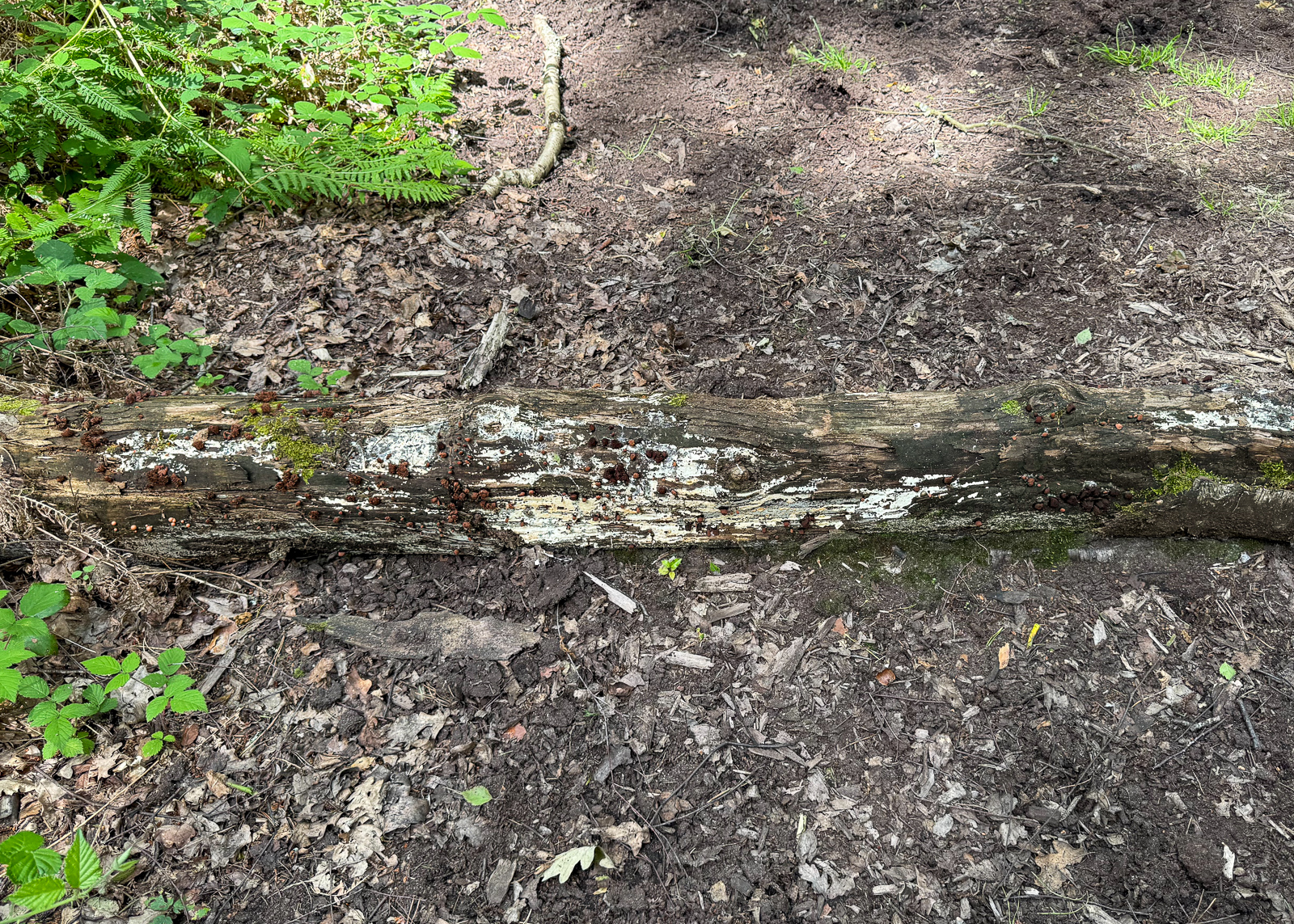
Sometimes the most remarkable wildlife is found on the smallest scale. A message from my daughter saying she had found Chocolate Tube Slime (Stemonitis spp.) on a fallen log on Elstead Common was too good to ignore. A short while later we were examining a log covered with slime moulds at several different stages of … Continue reading "Slime Moulds Sharing a Log"
Algae are a diverse collection of simple, primarily non‑vascular organisms that carry out photosynthesis but do not belong to the mosses or vascular plants. They range from microscopic green films to vivid orange surface growths and occur on tree bark, rocks, soil, freshwater, and marine habitats. Because algae span several distinct evolutionary lineages, they are … Continue reading "Other Photosynthetic Organisms — Algae"
Dicots (or eudicots in modern classifications) form the largest and most diverse branch of the flowering plants. They are characterised by having two seed leaves (cotyledons), net‑veined leaves, and floral parts often arranged in fours or fives. This group includes many of the world’s most familiar wildflowers, shrubs, and trees. From roses and sunflowers to … Continue reading "Flowering Plants — Angiosperms (Dicots / Eudicots)"
Monocots are one of the two major lineages of flowering plants and include many of the world’s most familiar species. They are characterised by having a single seed leaf (cotyledon), parallel‑veined leaves, and floral parts typically arranged in multiples of three. Monocots occupy an extraordinary range of habitats, from wetlands and grasslands to tropical forests … Continue reading "Flowering Plants — Angiosperms (Monocots)"
Gymnosperms are the oldest living seed plants, with origins stretching back more than 300 million years. Unlike flowering plants, their seeds are not enclosed within fruits; instead, they develop openly on the surfaces of cones or specialised reproductive structures. This ancient lineage includes conifers, cycads, ginkgos, and gnetophytes — groups that dominated Earth’s forests long … Continue reading "Seed Plants – Gymnosperms"
Work in progress… Seedless vascular plants represent an early and important stage in the evolution of land plants. Unlike bryophytes, they possess true vascular tissue (xylem and phloem), allowing them to transport water and nutrients internally and grow taller than their non‑vascular relatives. However, like mosses and liverworts, they still reproduce via spores rather than … Continue reading "Seedless Vascular Plants (Pteridophytes)"
Non‑vascular plants represent some of the oldest and most resilient lineages within the plant kingdom. Unlike vascular plants, they lack specialised conducting tissues (xylem and phloem), and instead absorb water and nutrients directly through their surfaces. This limits their size, but allows them to thrive in environments where other plants struggle — from shaded woodland … Continue reading "Non-vascular Plants (Bryophytes)"
Myriapods are terrestrial arthropods with elongated, segmented bodies bearing numerous legs. This group includes centipedes and millipedes, which are commonly found in soil, leaf litter, and under stones or logs. Most myriapods play an important role in ecosystems as predators or decomposers. Classes of Myriapods Myriapods are divided into four main classes: Class Diplopoda — … Continue reading "Subphylum Myriapoda — Centipedes & Millipedes"
Multicrustacea is a major group of crustaceans that includes many of the most familiar forms such as crabs, lobsters, shrimp, woodlice, barnacles, and copepods. Members of this group occupy a wide range of habitats, from oceans and freshwater to land. It is divided into two main classes: Malacostraca, which contains the larger and more recognisable … Continue reading "Superclass Multicrustacea — Typical Crustaceans"
Chelicerates are a major group of arthropods that includes spiders, scorpions, mites, ticks, horseshoe crabs, and sea spiders. Unlike many other arthropods they lack antennae and possess specialised mouthparts called chelicerae, which are often adapted as fangs or pincers used for feeding. Most chelicerates are terrestrial predators, although some groups remain marine. Chelicerates occur in both marine and … Continue reading "Subphylum Chelicerata — Spiders & Relatives"