Kingdom Bacteria (Eubacteria)
Bacteria are single‑celled prokaryotic organisms found in almost every environment on Earth. Although some species cause disease, most are harmless or beneficial, playing essential roles in nutrient cycling, decomposition, and many ecological processes. My own photographs of bacteria are limited, but this section is included to complete the overall classification framework.
How Bacteria Are Classified
Historically, bacteria were grouped by shape, a system introduced by Ferdinand Cohn in 1872. The main forms are still widely used today:
- Cocci – spherical
- Bacilli – rod‑shaped
- Vibrios – comma‑shaped
- Spirilla – spiral
- Spirochaetes – corkscrew‑shaped
- Actinomycetes – branching, filamentous forms
- Mycoplasma – lacking a stable shape
Modern classification also uses features such as:
- Cell wall structure (Gram‑positive = purple; Gram‑negative = pink/red)
- Nutrition (autotrophic or heterotrophic)
- Temperature tolerance
- Oxygen requirements
- Genetic and molecular characteristics
These methods help distinguish the major bacterial groups.
Major Bacterial Groups (Phyla)
A few of the most significant phyla include:
Actinobacteria
Filamentous bacteria common in soil and water. Many produce antibiotics (e.g., Streptomyces), while others are important decomposers or nitrogen‑fixers.
Cyanobacteria
Photosynthetic bacteria often called “blue‑green algae”. They played a major role in oxygenating the early Earth and form colourful mats in places like hot springs.
Firmicutes
A diverse group including bacilli, clostridia and mycoplasmas. Many species are common in soil and in the human gut.
Proteobacteria
The largest and most diverse bacterial phylum, including nitrogen‑fixers, symbionts, and many familiar genera.
Spirochaetae
Corkscrew‑shaped bacteria found in a wide range of environments.
Not all bacteria are microscopic.
Thiomargarita namibiensis and Epulopiscium fishelsoni can reach 600–750 μm, making them visible to the naked eye.
Extremophiles
Extremophiles can withstand conditions considered too extreme for most life forms.
- Thermophiles – high temperatures (range 45 to 80°C),
- Hyperthermophiles – very high temperatures (up to 122°C)
- Psychrophiles – cold environments (found in glaciers, below 15°C))
- Halophiles – high salt
- Acidophiles – very low pH (some as acidic as pH 0)
- Alkaliphiles – high pH (alkiline environments up to pH 10.5)
The colourful microbial mats in Yellowstone National Park are formed by thermophilic bacteria. Water from hot springs flows continuously, creating a cycle of hot water rising, cooling and sinking. This produces distinct temperature rings around the spring, with very hot water in the centre and progressively cooler zones radiating outward. Different bacterial communities thrive in each temperature band, creating the vivid rainbow colours. The photographs below show some examples from my visit there.
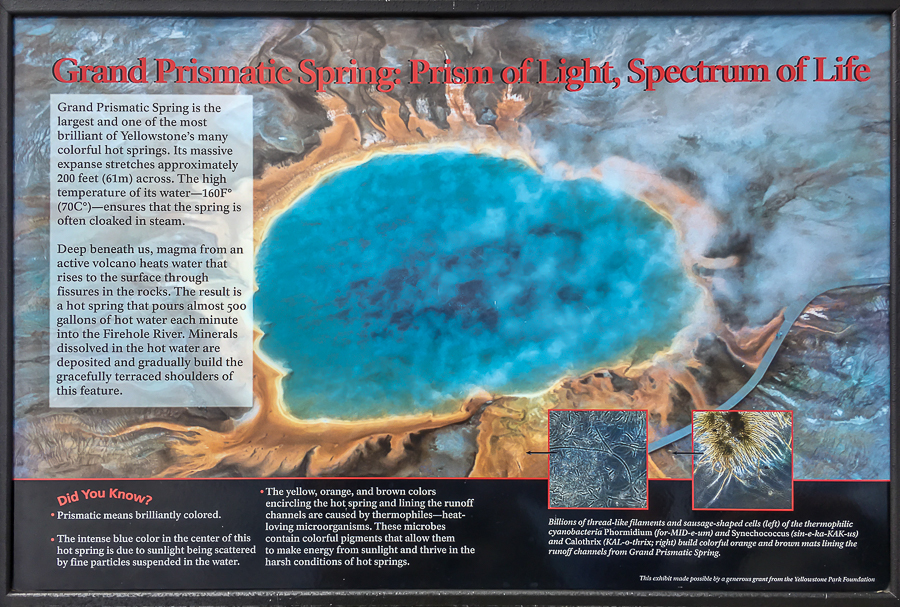
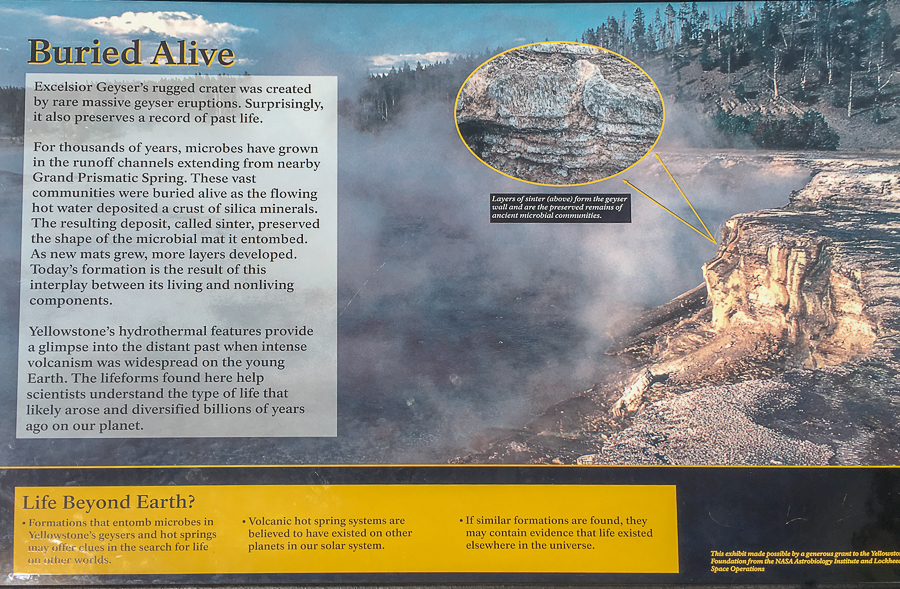


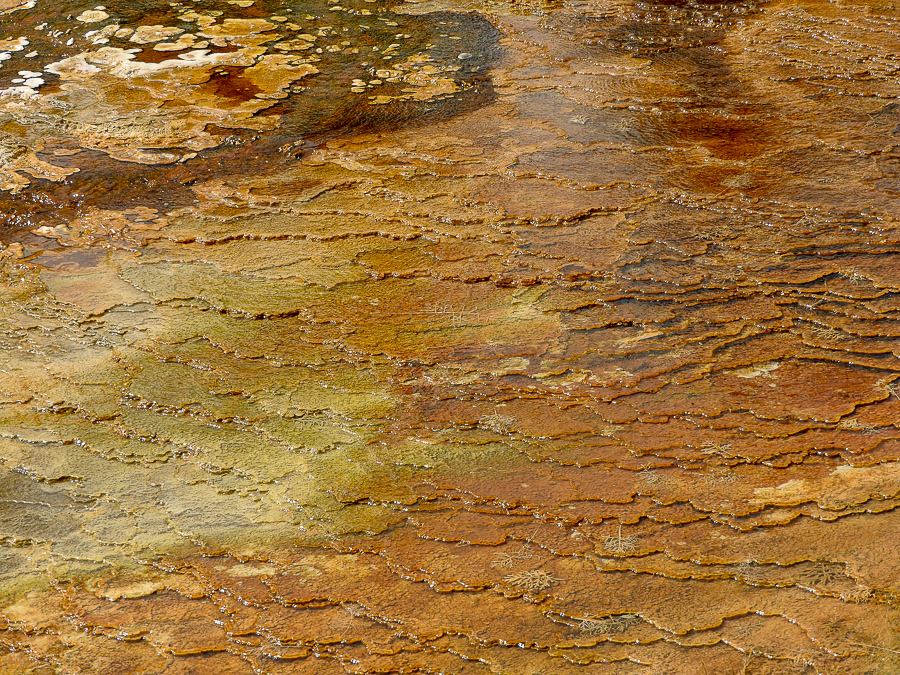
Table of thermophilic bacteria found in Yellowstone National Park1
| Name | Temperature | Description | Location |
|---|---|---|---|
| Cyanobacteria Calothrix |
30–45°C 86–113°F |
Colour: dark brown mats Metabolism: photosynthesis by day; fermentation by night |
Mammoth Hot Springs Upper, Midway, and Lower Geyser Basins |
| Phormidium | 35–57°C 95–135°F |
Color: orange mats Metabolism: photosynthesis |
Mammoth Hot Springs Upper, Midway, and Lower Geyser Basins |
| Oscillatoria | 36–45°C 96–113°F |
Color: orange mats Metabolism: photosynthesis; oscillating moves it closer to light sources. |
Mammoth Hot Springs Chocolate Pots |
| Synechococcus | 52–74°C 126–165°F |
Color: green mats Metabolism: photosynthesis by day; fermentation by night |
Mammoth Hot Springs Upper, Midway, and Lower Geyser Basins |
| Green Sulfur Chlorobium |
32–52°C 90–126°F |
Color: dense, dark green mats Metabolism: anaerobic photosynthesis— produces sulfate and sulfur, not oxygen. |
Mammoth Hot springs Calcite Springs |
| Green non-sulfur Chloroflexus |
35–85°C 95–185°F |
Color: green mats Metabolism: anaerobic photosynthesis |
Mammoth Hot Springs Upper, Midway, and Lower Geyser Basins |
| Aquifex Hydrogenobaculum |
55–72°C 131–162°F |
Color: yellow and white streamers Metabolism: uses hydrogen, hydrogen sulfide and carbon dioxide as energy sources; can use arsenic in place of hydrogen sulfide. |
Norris Geyser Basin Amphitheater Springs |
| Deinococcus-Thermus Thermus |
40–79°C 104–174°F |
Color: bright red or orange streamers Contains carotenoid pigments that act as sunscreen. |
Lower Geyser Basin |
References
- Thermophilic Communities – Yellowstone National Park Services